
Bridge production injection molding should be scoped as a temporary operating system with a defined job, evidence boundary and end condition. Its job may be to cover an initial release, prevent an assembly interruption while a later tool is prepared, or provide production-representative parts while a forecast is tested. It is not a shortcut around a released specification, qualification plan or supply agreement. Before ordering, the buyer should be able to explain what demand is covered, which configuration is supplied, what the bridge lot must prove and who decides when the programme changes route.
The later production injection molding system may not be a simple enlargement of the bridge. Cavitation, cooling, resin handling, automation, inspection, packaging and logistics can all change. A sound scope creates a deliberate handoff between systems. It gives engineering a controlled baseline, purchasing a commercial boundary and operations a practical way to protect customers without treating early parts as proof of every future condition. Tooling, material, inspection and delivery assumptions remain part- and contract-specific and should be verified with the selected supplier and relevant product specialists.
Use two exit tests: can the bridge continue to cover the agreed demand window, and is there enough controlled evidence to release the next production route?
01
Start with a bridge charter, not a temporary purchase order
A bridge charter is a short decision record agreed before tool release or the first lot. Name the commercial purpose, part numbers and controlled revisions, forecast scenario, release pattern, material and colour direction, acceptance basis, and the event that ends the bridge. That event might be approval of a later tool, closure of a design change, a forecast decision or a planned stock position. “Until mass production” is not an exit event. Without a visible end condition, a temporary route can become an unplanned long-term one with unclear limitations.
Do not choose a route from order quantity alone. Low volume injection molding may protect a defined demand window, while a more developed tool can be warranted for a modest quantity when the part has critical interfaces, inserts, visible surfaces or a high consequence of interruption. State the forecast as committed releases, planning releases, likely upside and stock-out consequence. Also separate what must remain stable in the bridge—such as geometry, functional interfaces, resin direction and pack-out—from what is still provisional. That makes an open decision visible before it becomes an uncontrolled change.
| Bridge question | Record before the first lot | Reason for recording it |
|---|---|---|
| What demand is covered? | Release window, forecast scenarios, permitted inventory and replenishment owner. | Separates immediate supply protection from an open-ended commitment. |
| What configuration is supplied? | CAD and drawing revision, material direction, approved deviations and revision authority. | Prevents the next route inheriting a mixed baseline. |
| What must the bridge prove? | Named fit, function, visual, dimensional or pack-out questions and observation method. | Stops limited evidence being treated as universal validation. |
| What ends the bridge? | Decision event, accountable owner and fallback if the event is delayed. | Creates a planned decision point. |

02
Expose the production gap in the tool and process plan
Review the bridge and later tool as connected but separate systems. Ask for a side-by-side explanation of parting line, gates, runner and cavity approach, cooling and venting, ejection, resin preparation, inserts or secondary operations, and the expected modification route. This does not require the bridge to duplicate every production feature. It identifies differences that could change appearance, fit, mechanical behaviour, measurement or supply risk. Published design guidance on draft, wall sections, undercuts and finish is useful for framing questions, but a published limit is not a universal capability claim. Confirm it against the actual part, resin and proposed tool.
For each critical feature, ask whether the bridge gives production-intent evidence. An intended resin can help investigate shrinkage, assembly fit or a cosmetic zone only when gate, cooling, cavity and processing conditions make the observation relevant. A temporary gate or manual insert-loading step may still be suitable for the bridge purpose; the production review must state what is to be reassessed. The injection molding ramp-up should likewise reveal fixtures, gauges, traceability, operator-sensitive work, handling, packaging and deviation disposition. For regulated, safety-relevant or reliability-critical products, the product owner should define separate validation and documentation duties with competent specialists; a bridge lot does not establish approval or fitness for use.
| Area | Bridge question | Question for the later route |
|---|---|---|
| Material and colour | Is the grade direction and substitution rule recorded? | Does the approved material definition remain unchanged? |
| Tooling and process | Which tool features or manual steps are unique? | Could cavities, cooling, gates or automation affect a CTQ? |
| Inspection | Which datums, visual zones and conditions are checked? | Is a different gauge, sample plan or review needed? |
| Pack-out | What handling and packaging are represented? | What changes at the intended release rate or shipping lane? |
03
Use two acceptance gates instead of one broad approval
Bridge acceptance and mass-production readiness answer different questions. The lot-release gate asks whether an identified lot meets the acceptance criteria for its stated bridge purpose. Record the sample or lot, revision, material identification, tool status, agreed dimensional and visual checks, assembly or functional observations, deviations and disposition. A passing lot means the defined evidence was acceptable under those conditions. It does not automatically approve a future material substitution, changed mold, different cavity layout or new shipment condition.
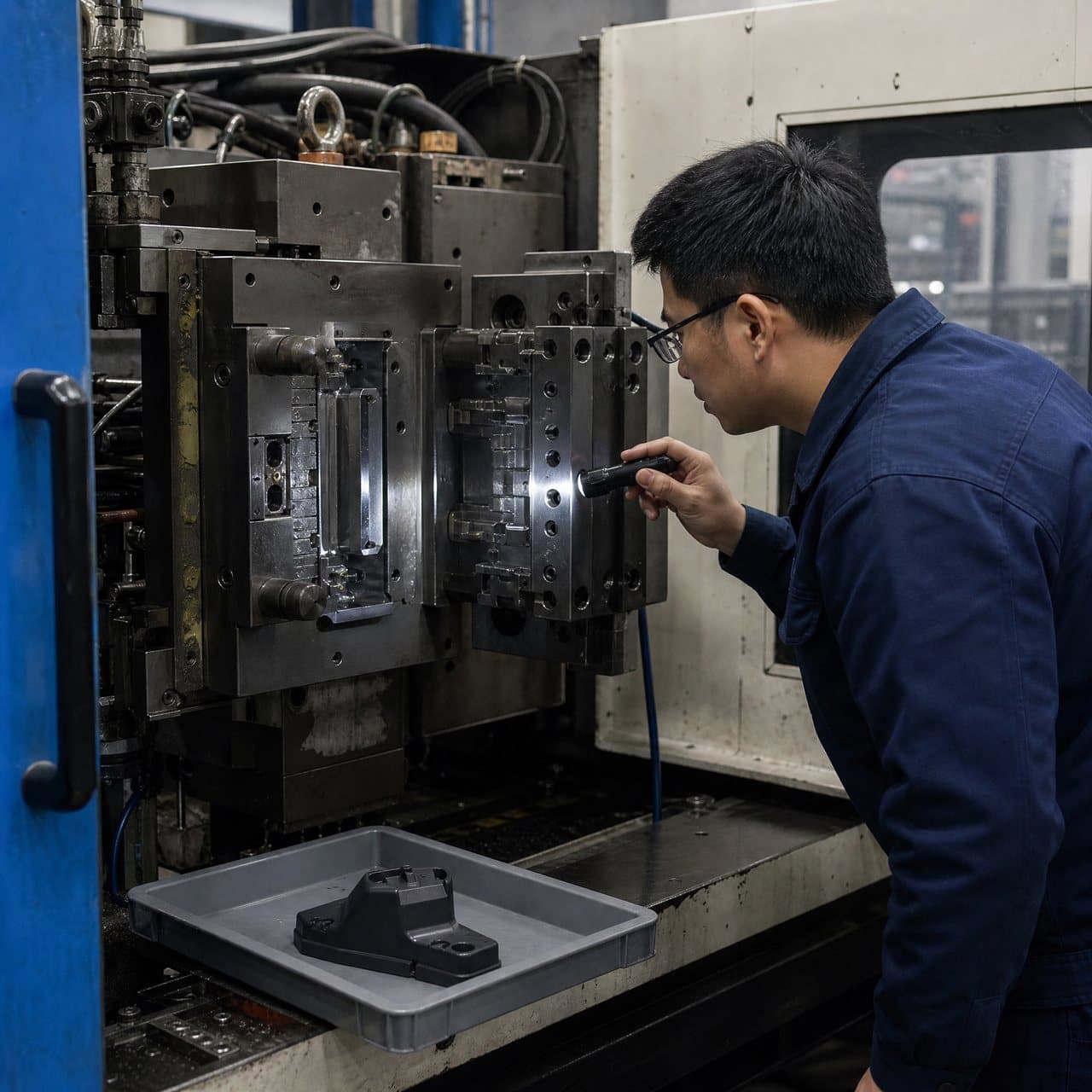
The transition gate asks whether there is a controlled basis to release the later system. Review bridge evidence alongside the proposed production configuration, remaining risks, changes between routes, acceptance plan, change-notice rules, packaging and delivery assumptions. Buyers in Europe, North America and the Middle East may share a global drawing but have different importer, customer, language, customs or documentation needs. Record requirements supplied by the buyer rather than assuming one region's requirements apply everywhere. ISO 20457 provides a framework for tolerance and acceptance conditions for moulded plastic parts; it does not select the critical features or measurement method for a particular product. Those choices need agreement by the responsible engineering and quality functions.
04
Treat continuity as a managed fallback, not an assurance
Injection molding supply continuity improves when the scope says what happens if the planned transition moves. Start with the consequence: which customer build, service obligation or assembly sequence is affected if parts are unavailable? Then agree a response hierarchy, such as an additional bridge release, a controlled inventory buffer, a tool-condition review, an approved alternative route or a revised production decision. The right choice depends on part criticality, demand uncertainty, tool condition, material availability, cash exposure and contract terms. Do not presume backup capacity, inventory or alternate material unless it is specifically agreed and verified.
Cross-border continuity needs an explicit delivery boundary. State the named destination, selected Incoterms version, packing and labelling requirements, party responsible for export and import formalities, required shipping documents and the point at which risk transfers. Incoterms allocate specified transport tasks, costs and risks, but do not settle product conformance, ownership transfer, payment terms or every contractual remedy. Obtain appropriate logistics, customs and legal advice for the transaction. Also verify who holds the tool, who authorizes maintenance or access, how revisions and resin identity are controlled, and which buyer-supplied insert, resin grade, gauge, packaging component or transport lane is a meaningful single point of failure.
05
Close the bridge with a transfer dossier and a decision
Begin the handoff record before the bridge starts. Retain the part and drawing revision, CAD release, material and colour definition, tool status, DFM decisions, relevant gate or cosmetic decisions, inspection plan and results, visual reference, deviations, packing specification, change log and demand history. If the tool may be retained, modified, moved or replaced, record the intended action and review conditions. Tool ownership, intellectual-property rights, storage, access and transfer are contractual matters; confirm them in the governing agreement rather than inferring them from an invoice.
At the final review, ask: what did the bridge supply; what evidence transfers; what changed or remains unresolved; and what decision is required now? This makes the follow-on quote comparable and prevents the same unknown from being paid for twice. Short run injection molding should be respecified rather than automatically extended when demand loses its boundary, tool condition changes, or product changes make previous evidence less relevant. Move to the next system when the technical configuration, acceptance basis, supply responsibilities and decision authority are clear enough for the programme—not at an arbitrary volume.
Practical takeaway
Before you move
to the next review.
- Issue a bridge charter naming the demand window, controlled configuration, intended evidence and exit event.
- Request a side-by-side explanation of bridge and later tooling, material, inspection, handling and packaging assumptions.
- Set a lot-release gate and a separate transition gate; state what each does and does not approve.
- Verify the named delivery place, Incoterms version, document responsibilities and buyer-supplied regional requirements.
- Maintain a transfer dossier and written fallback decision for a delayed transition, changed tool condition or demand shift.
FAQ
Common questions
Should bridge parts use the final production resin?
Where material-dependent fit, appearance, strength or environmental behaviour matters, the intended approved resin direction can make a bridge more informative. Confirm the grade, colour, conditioning, processing assumptions and any permitted substitutions. If the later route changes material, cavities or process in a way that can affect a critical result, define what must be reviewed again.
Can a bridge tool continue after mass production begins?
It may be retained for contingency, service demand or a planned overlap, but that is separate from approving the main route. Review tool condition, releases, maintenance and storage responsibility, part revision, material availability, inspection basis, ownership or access rights, and change-control implications. Do not assume a temporary tool provides equivalent capacity or part characteristics.
What should a buyer ask when a supplier proposes bridge production?
Ask what demand and configuration are covered; how the bridge differs from the proposed long-term system; what will be inspected and retained; what changes need notice or approval; what triggers the transition; and what happens if it is delayed. Request stated commercial, technical and logistics assumptions, then verify that they match the buyer's product, contract and destination-market needs.
References
Source material
- [1] International Organization for Standardization, ISO 20457:2026, Plastics moulded parts — Tolerances and acceptance conditions.
- [2] Protolabs, How to Use Injection Molding for Bridge Tooling.
- [3] Protolabs, Design Guidelines: Plastic Injection Molding.
- [4] International Trade Administration, Know Your Incoterms.
This guide is general information for early procurement and engineering discussion. It does not replace product-specific DFM, qualification, validation, regulatory assessment or legal advice.