
Buyers should outsource injection molding secondary operations when the molded part, joining or decoration step must be controlled as one product flow, or when managing separate suppliers would create avoidable handling, traceability or acceptance risk. Keep operations separate only when a specialist process, regional final assembly or commercial constraint clearly outweighs that integration benefit. The decision is not about adding services to a purchase order; it is about assigning ownership for the finished custom molded plastic parts and their evidence.
A secondary operation belongs in the molding supplier’s scope when a defect can originate at the handoff between molding, handling and finishing, but the buyer needs one accountable root-cause path.
01
Start with the failure mode, not the process name
Secondary operations include joining, decorating, inserting, trimming, inspection, packing and subassembly performed after a part leaves the mold. For a buyer in Europe, the United States or the Middle East, the practical question is where a nonconforming finished item could first be detected and who can contain it. If a logo rubs off, a housing leaks, a clip is damaged during transport or a left-right component is mixed, a low piece price at the molding stage may not represent the lowest program risk.
Bring an operation into the molding supplier’s scope when it depends on the as-molded surface, geometry, material lot, cosmetic class or controlled handling. This is especially relevant for injection molding pad printing and injection molding ultrasonic welding. The welding process uses high-frequency vibration while the parts are held under pressure, and the plastic interface is normally designed to concentrate melting locally [1]. That means the molded joint geometry, fixture support and weld process cannot be evaluated independently.
Do not assume that all post-molding work should be consolidated. A separate specialist can be sensible when it owns a genuinely different technology, when final configuration must occur near the destination market, or when the buyer must retain direct control of a regulated or proprietary step. In each case, define the physical handoff and the party responsible for defects found after it.

02
Compare integrated and split sourcing against the same acceptance plan
Ask each bidder to quote the same process map rather than simply asking whether it offers assembly. The map should identify incoming status, storage condition, fixturing, operation sequence, inspection point, rework rules, final packing and data retained. This prevents an apparently integrated quotation from hiding an unmanaged subcontract handoff.
The comparison below is a sourcing framework, not a universal rule. Any throughput, sampling level, dimensional limit, cosmetic threshold or test method must be confirmed for the specific project. A buyer should use it alongside the drawing, material specification and product risk assessment.
| Operation | Integrated scope is often stronger when | Split sourcing may fit when | Evidence to request |
|---|---|---|---|
| Pad printing | Print adhesion and appearance depend on the as-molded surface, cleanliness, colour and handling. | A specialist decoration process or regional language variant is required. | Approved artwork, colour reference, substrate and ink compatibility, cure plan, adhesion and abrasion acceptance method. |
| Ultrasonic welding | Joint geometry, resin behaviour, fixture support and leak or strength acceptance are interdependent. | The product design is already validated around a dedicated assembly specialist. | Joint drawing, horn and fixture concept, parameter window, destructive or functional test plan and weld traceability. |
| Plastic part assembly | Component orientation, clips, inserts, labels or packaging can be verified before parts leave the production flow. | Final build needs buyer-controlled electronics, software loading or destination-market configuration. | BOM revision, work instruction, poka-yoke approach, inspection records, segregation and pack-out specification. |
03
Treat pad printing as a surface-and-cure specification
Pad printing can place a mark on curved or irregular molded surfaces, but it should not be specified only as a colour and an artwork file. The resin grade, mould texture, release-agent controls, handling, cleaning method, ink system, pretreatment and cure conditions can all change the result. Plastics Decorating notes that polypropylene and polyethylene may need pretreatment for ink adhesion, and that contamination, unsuitable ink choice and incomplete cure are common failure paths [3].
For injection molding pad printing, send a controlled visual reference that distinguishes critical brand marks from noncritical information. State the viewing conditions, permitted print-location variation, acceptable edge definition and the test method for adhesion, abrasion or chemical exposure where applicable. Request samples that have completed the specified cure before sign-off. A print that appears dry is not automatically fully cured; the source explains that drying and cure are different states [3].
Outsource this step with the molder when the printed zone is a cosmetic CTQ, when parts require protected handling between molding and printing, or when a single supplier can prevent mix-ups between resin colour, artwork revision and packaging. If the decoration provider is separate, require a documented cleaning, storage and change-control handoff rather than relying on visual approval alone.
04
Outsource ultrasonic welding only after the joint is designed for it
Ultrasonic welding is not a generic sealing service that can be added after tooling release. TWI explains that plastic interfaces are typically designed with contact features that concentrate the melting process [1]. Dukane’s design guide further warns that a flat butt joint can create erratic welds because only high points contact first; it describes energy directors, alignment and flash control as part-design issues [2].
Therefore, place injection molding ultrasonic welding in the same scope as molding when the program needs a sealed enclosure, a strength-critical joint or controlled cosmetic appearance at the seam. The supplier should review the mating parts together, not just receive loose components after a mold trial. The request should identify resin grades, material compatibility assumptions, joint type, allowable flash, location features, nest support, functional test and the rejection response.
Fixtures deserve explicit buyer attention. A fixture aligns and supports the part so energy reaches the joint repeatably; insufficient support can change weld quality [2]. Ask for the proposed locating philosophy and for confirmation of how part variation will be contained. Do not accept a nominal weld setting as proof of capability. Define the required test evidence and any project-specific process monitoring before production approval.

05
Assign one owner for the finished-part release
The central commercial decision is accountability. If the molder manages printing, welding or plastic part assembly, the purchase order should state whether the supplier releases the finished assembly or only performs an operation to buyer instructions. Finished-part release is stronger when it includes revision control, component identity, workmanship criteria, functional checks, nonconformance segregation and packing verification. The buyer still owns the product requirements, but should not have to arbitrate whether a defect began at molding, transport or assembly.
A split model can work if each supplier has a precise boundary. Define who owns damage in transit, how lots are identified, which inspection is repeated at receipt, whether rework is allowed, and how a drawing or artwork revision is quarantined. This is particularly important for cross-border flows, where an unlabelled partial lot or an unclear packaging condition can delay containment. Protolabs identifies design for assembly alongside design for cost, quality and manufacturability as a relevant part-design consideration [4]; use that same cross-functional view in supplier selection.
Before award, run a project-specific pilot or first-article plan that follows the real route from molded component to packed finished part. Results should be reviewed against defined requirements, not against a supplier’s general brochure. Any example quantities, test frequency or production timing should be agreed in the project quality plan rather than inferred from this article.
06
Request a secondary-operations review before issuing the RFQ
Send the 3D model, controlled drawing, resin and colour specification, BOM, artwork, expected market configuration, target annual demand range, proposed test requirements and packing concept. Identify the functional and cosmetic CTQs, then ask the supplier to return a process map, open issues and a quote that separates tooling or fixtures from recurring operations where relevant. This gives purchasing, engineering and quality one basis for comparing an integrated route with a split route.
For a project involving custom molded plastic parts, request a quotation and a project-specific review of the molding, decoration, joining and inspection interfaces. The useful outcome is a clear scope of responsibility and evidence plan, not an unsupported promise about capability, price or lead time.
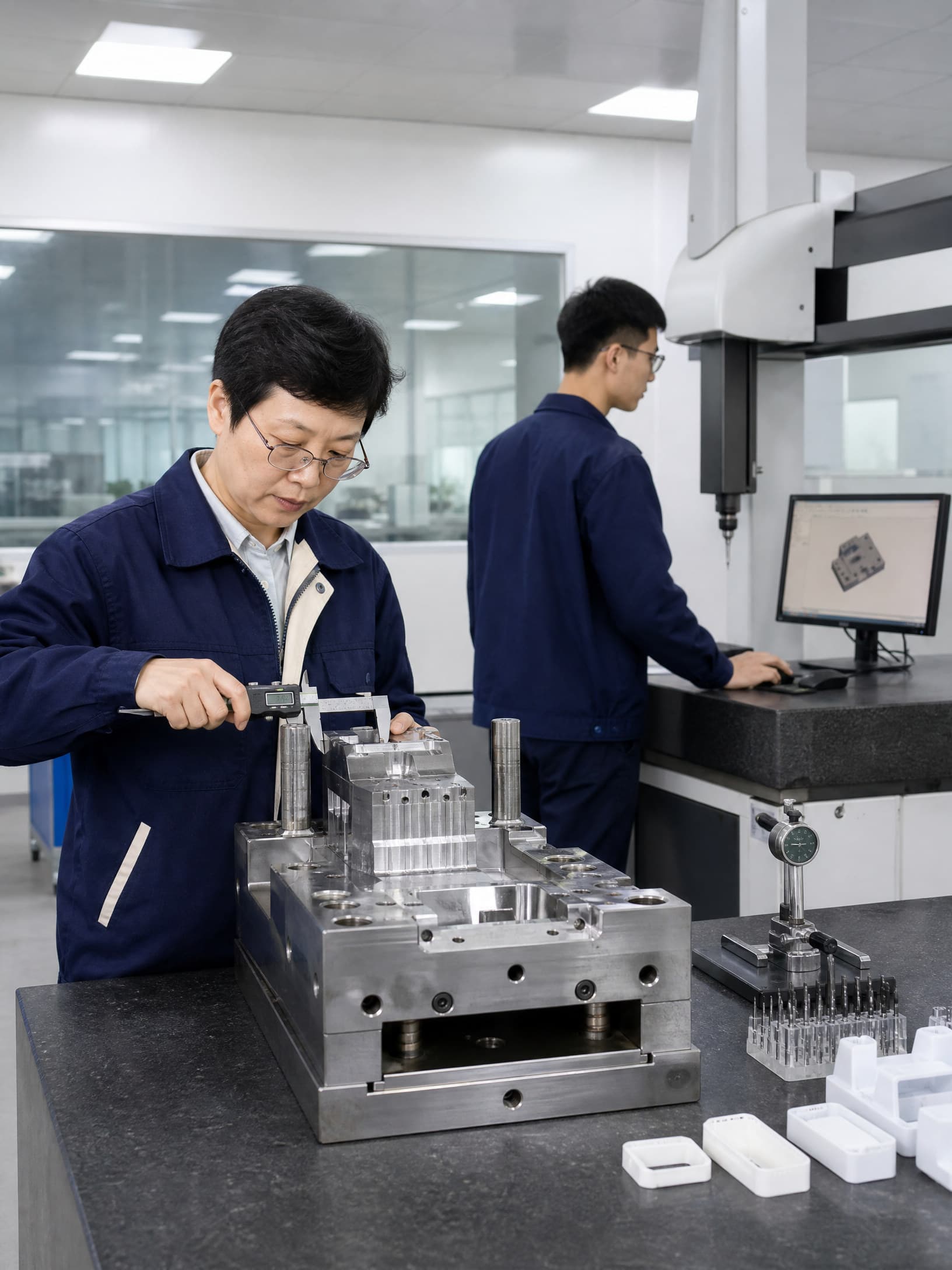
Practical takeaway
Before you move
to the next review.
- Identify every operation after molding and mark where cosmetic, functional or traceability risk first appears.
- Provide controlled drawings for all mating parts, joints, artwork, labels and pack-out requirements.
- For pad printing, specify the resin grade, print zone, visual standard, ink compatibility, pretreatment need, cure requirement and acceptance test.
- For ultrasonic welding, request a joint-design review covering alignment, flash management, fixtures, functional testing and containment of part variation.
- Decide whether the supplier releases a finished part or only performs a defined operation, and write the boundary into the purchase order.
- Require lot identification, revision control, nonconformance segregation, rework approval and handoff packaging rules for every split-sourcing interface.
- Agree the project-specific first-article, validation and ongoing inspection evidence before production approval.
FAQ
Common questions
Is it always cheaper to combine secondary operations with injection molding?
No. Consolidation can reduce handling and coordination, but a separate specialist may be the better route for a distinct technology, local final configuration or buyer-controlled process. Compare total risk, logistics, inspection ownership and evidence, not only the unit-price line.
What must be supplied for a pad printing quotation?
Provide the controlled artwork, colour reference, resin grade and colour, molded-surface requirement, print location, inspection standard, exposure or abrasion test if needed, expected demand range and packing condition. Confirm whether pretreatment and curing are part of the proposed process.
Can ultrasonic welding be added after the mold is built?
It may be possible, but it should not be assumed. Joint geometry, alignment, energy concentration, fixture support, material and acceptance criteria affect weld performance. Review the mating-part design and validate the specified functional requirement before committing to the operation.
References
Source material
- [1] TWI Global — What is Ultrasonic Welding and How Does it Work?
- [2] Dukane — Ultrasonic Welding Design Guide
- [3] Plastics Decorating — Solutions to Pad Printing Adhesion Problems
This guide is general information for early procurement and engineering discussion. It does not replace product-specific DFM, qualification, validation, regulatory assessment or legal advice.