
Scope it as a part-specific evidence plan, not as a blanket material or supplier claim. Define the part’s intended use, applicable market and customer requirements, and the decisions the evidence must support. A resin described as ‘medical grade’, a clean-looking molded part or a supplier document alone does not establish that the finished product is suitable, validated or approved for a particular medical use.
For medical grade plastic injection molding, name the intended part application, relevant contact and exposure assumptions, controlled material route, acceptance criteria, traceability, change boundaries and approver. This gives procurement a usable quotation while leaving product-specific regulatory, biological-evaluation and validation decisions with the organisation that owns the device and market strategy.
FDA states that its QMSR applies to finished-device manufacturers; a component quotation or resin label is not, by itself, evidence that a finished device meets applicable requirements.[1]
01
Set the claim boundary before selecting a polymer
Start with the part’s intended role rather than the phrase ‘medical grade’. Record the intended market; whether the part or its materials may directly or indirectly contact the body; contact type and duration if known; and sterilisation, chemical or environmental exposure assumptions. FDA’s ISO 10993-1 guidance addresses devices with direct or indirect body contact and describes a risk-based approach to deciding whether biocompatibility testing is needed.[3] The relevant decision is therefore part-specific, not a generic property of a resin family.
Separate commercial language from claims your team needs to support. Ask for exact grade identification, available technical and regulatory documentation, formulation or change-control information where offered, and stated limitations. Do not convert those documents into a finished-component claim: geometry, colorants, additives, processing, cleaning, assembly, packaging, sterilisation and intended use can matter. In medical injection molding, two parts made from the same named grade can need different evidence and review routes.
02
Assign regulatory and quality responsibilities explicitly
A quotation request should identify who owns the finished-device specification, regulatory strategy, risk management, biological evaluation, design changes and release decision. State the molder’s requested work plainly: make samples to an agreed revision, use an identified material route, record specified production information, perform agreed checks or retain lot traceability. FDA says the U.S. Quality Management System Regulation became effective on 2 February 2026 and incorporates ISO 13485:2016 by reference; it applies to finished-device manufacturers that intend commercial distribution.[1] That is context, not a basis for assuming every component maker or market has the same obligation.
ISO describes ISO 13485 as a quality-management standard for organisations involved in medical-device design and manufacture, including suppliers and external parties.[2] Translate this into contractual questions: which documents are required, what change notice is expected, which records accompany samples or lots, and who approves an exception? A request for a certificate, test or validation should name the standard, document revision, scope, criterion and responsible organisation. If unknown, mark it ‘to be defined’ rather than imply compliance.
03
Build a material and manufacturing evidence plan around the decision
Make the material record specific enough to preserve identity through molding: polymer manufacturer, grade, color or additive direction, lot identity where required, relevant supplier documents, and the response if the named source or formulation changes. Some medical portfolios offer enhanced raw-material controls, documentation and change notification; BASF describes these features for specified PRO products.[4] Verify the exact grade and service conditions rather than assuming that an unqualified product name provides the same support.
Choose evidence according to the decision. A feasibility sample may need only revision control, material identity and focused dimensional or functional observations. A design-transfer or production-release decision may need an inspection plan, lot identification, agreed records and a change pathway. Injection molding process validation should be requested only where the customer’s quality system, contract or risk assessment defines that objective. State the part, tool, material, process scope, protocol, acceptance basis and approval authority; it is not a promise that later tools, formulations or revisions will perform identically.
| Buyer decision | Proportionate scope to define | Evidence that may support it | What not to infer |
|---|---|---|---|
| Quote and manufacturability review | Released or provisional drawing, intended role, material direction, forecast, open assumptions and requested supplier work. | DFM comments, preliminary tool and process assumptions, named material route and priced exclusions. | A quote does not establish material suitability, regulatory status or production release. |
| Engineering sample decision | Sample purpose, drawing revision, tool status, requested checks, sample quantity and disposition route. | Traceable sample IDs, focused dimensions or function observations, material identification and open-issue list. | A successful sample is not automatically a validated routine-production process. |
| Customer-defined validation or transfer | Protocol owner, acceptance criteria, planned production conditions, deviations, records and approval authority. | The agreed protocol, results, review record and change-control linkage. | A generic ‘validated’ label is not enough without the defined scope. |
| Routine lot release | Lot definition, characteristics, method, frequency, traceability, report format and reaction plan. | Agreed inspection records, material or lot traceability where required, and documented disposition. | Routine checks do not replace the device owner’s product-specific compliance decisions. |

04
Specify controls, records and changes before the purchase order
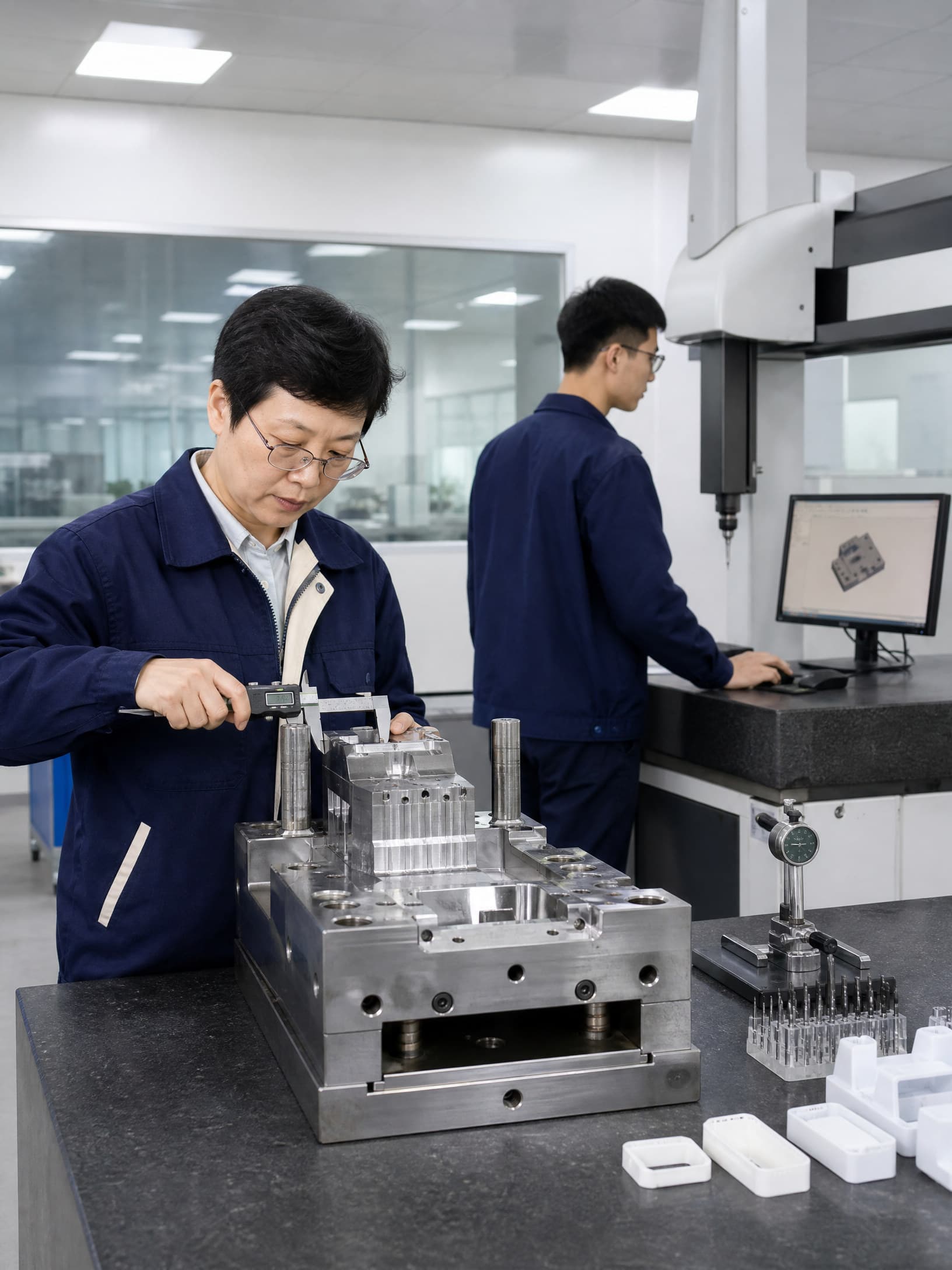
Write only the checks that support a stated requirement. An injection molding inspection plan should identify the controlled part revision, characteristic or function, acceptance criterion, method or fixture condition where important, timing, sample or lot basis, record and response to a suspect result. The plan should not treat all drawing dimensions as equally critical. For example, a sealing interface, assembly datum, visual reference surface or insert presence may need a different method and reaction path from a non-functional reference dimension. Measurement conditions, including part conditioning and datum setup, should be agreed when they could affect the decision.
Define the contents of the injection molding quality report before a run: part and drawing revision, tool or cavity identifier where relevant, material identity, run or lot identity, sample basis, measured or assessed requirements, disposition, date and reviewer. Also agree which changes need notice, evidence, sample review or written reapproval. Relevant triggers may include a resin-grade, colorant or additive change; tooling repair that may affect the part; cavity addition; processing change beyond the agreed boundary; revised inspection method; or packaging change that could affect the stated requirement. ISO 13485’s focus on consistent production, delivery and risk management makes a documented change boundary a practical sourcing control, but its detail remains part- and contract-specific.[2]
05
Turn the quote request into an accountable next step
A clear request avoids both under-scoping and unsupported promises. Send the current drawing and CAD if available, explain the part’s intended role and market, identify the preferred grade or the material-selection question, state the evidence needed at each stage, and call out known exposure or assembly conditions. Name the buyer contact who can clarify requirements and the internal function that will decide regulatory or validation matters. Where the component will contact the body, involve the device owner’s regulatory, quality and materials specialists early; FDA’s guidance is directed at evaluating the potential for unacceptable biological response from device component materials in the context of submissions, not at conferring a universal material approval.[3]
Before asking for price or an engineering review, use the checklist below to turn broad medical language into an auditable brief. The goal is not to make an ordinary molded component sound like a finished medical device. It is to obtain a quote, sample plan and evidence package that accurately support the next buyer decision. Prepare the requested scope, identify the unresolved assumptions, and use the quote-request route to ask for an engineering discussion tied to the exact part.
Practical takeaway
Before you move
to the next review.
- State the part’s intended role, target market, relevant contact and exposure assumptions, and open assumptions for the device owner.
- Name the controlled drawing or CAD revision, material manufacturer and grade direction, and required traceability information.
- Separate quotation, engineering-sample, customer-defined validation and routine-release decisions; assign an owner and acceptance route to each.
- Define part-specific inspection characteristics, methods, report contents, lot or sample basis, and the response to suspect results.
- List material, tool, process, measurement, assembly and packaging changes needing notice, review, sample evidence or reapproval.
FAQ
Common questions
Does a medical-grade resin make the molded part medical grade?
No. It can identify a material route and available documentation, but does not establish the suitability, biological evaluation, regulatory status or validation of a finished molded part. Those conclusions depend on the device, intended use, finished configuration and applicable market requirements.[3]
Should every medical project require process validation from the molder?
No. Request the evidence that the device owner’s quality system, risk assessment, agreement and part purpose require. If validation is required, define the protocol, part and process boundary, criteria, records and approval authority. ISO 13485 is a quality-system framework, not an identical evidence package for every molded component.[2]
What is the minimum useful evidence to request with a sample?
For an early engineering decision, ask for the part revision, sample identification, stated material grade, tool status, agreed focused inspection or functional observations, and open issues. Add lot traceability, formal reports or change controls only when the next decision requires them. Do not present an exploratory sample as production or regulatory evidence.
References
Source material
- [1] U.S. Food and Drug Administration, “Quality Management System Regulation (QMSR).”
- [2] International Organization for Standardization, “ISO 13485:2016 — Medical devices — Quality management systems — Requirements for regulatory purposes.”
- [3] U.S. Food and Drug Administration, “Use of International Standard ISO 10993-1, Biological Evaluation of Medical Devices — Part 1.”
- [4] BASF Performance Materials, “Medical Technology: Engineering Plastics for Patient Safety.”
This guide is general information for early procurement and engineering discussion. It does not replace product-specific DFM, qualification, validation, regulatory assessment or legal advice.