
Buyers should set sampling plans and AQL by classifying defects against part risk, defining the lot and random-selection method, then documenting acceptance, rejection, containment, and re-inspection rules before release. Use AQL sampling to decide on a lot, not to prove process capability or protect every critical-to-quality requirement. For safety, regulatory, fit, function, or traceability requirements, specify the verification method and any full-inspection or validation rule separately.
AQL is a lot-acceptance tool, not blanket permission for defects. Put every injection molding CTQ, defect class, sampling method, and escalation rule in the approved inspection plan.
01
Start With the Release Decision and Lot Definition
First define the decision: shipment release, in-process monitoring, trial approval, or corrective-action verification. Acceptance sampling uses a random sample to decide whether a lot is likely acceptable; it is not a substitute for process capability evidence, dimensional studies, or validation. NIST distinguishes this short-run lot decision from long-term quality control [2].
Define a lot in physical and commercial terms: for example, a project-confirmed production run, shift, resin batch, or shipment. The identifier should link the part to drawing revision, tool and cavity where applicable, resin and color batch, date, and approved deviation. The plan also needs the sampling stage, random-selection method, measurement tools, responsible person, and release record. FDA guidance calls for these elements, including representative selection and nonconforming-product handling [3].

02
Convert Requirements Into CTQs and Defect Classes
Mark every injection molding CTQ on the drawing and inspection plan. For each one, state the datum or location, tolerance, measurement method, gauge resolution, frequency, and decision owner. CTQs are requirements whose variation can affect safety, compliance, fit, function, assembly, a defined cosmetic zone, or traceability.
Classify defects by effect rather than ease of detection. A critical defect can create a safety, regulatory, sealing, electrical, essential-function, or traceability risk. A major defect can prevent agreed fit, function, assembly, or cosmetic acceptance. A minor defect has no defined functional effect. Confirm project-specific definitions with annotated photos, approved limit samples, and clear drawing callouts; an AQL table cannot solve ambiguous criteria.
| Control area | Critical CTQ | Major defect | Minor defect |
|---|---|---|---|
| Typical effect | Safety, compliance, sealing, essential function, or traceability risk | Fit, function, assembly, or agreed cosmetic failure | No defined functional effect |
| Inspection approach | Project-confirmed method; full inspection or validation may be needed | Risk-based attribute sampling plus targeted measurement | Risk-based attribute sampling and visual standard |
| Release evidence | Method, result, traceability, disposition | Sample, count, decision, disposition | Sample, count, decision, disposition |
03
Choose the AQL Plan From Risk, Not a Generic Number
AQL attribute plans pair a lot size, inspection level or severity, sample size, and acceptance/rejection numbers with each defect class. ISO 2859-1 is a recognized framework for lot-by-lot inspection by attributes indexed by AQL [1]. State the agreed standard or method, edition, plan type, inspection level, switching rules if used, and whether the plan counts nonconforming units or nonconformities. “AQL inspection required” is incomplete.
Set project-confirmed values after assessing failure consequence, detectability before use, part complexity, defect history, assembly sensitivity, cosmetic zone, traceability, and strength of process evidence. Critical CTQs usually need stricter, separately stated controls. FDA explains that an operating-characteristic curve relates defect percentage to the chance of acceptance [3]. An accepted lot can contain defects; where residual risk is unacceptable, add prevention, targeted checks, containment, or full verification rather than relying only on AQL.
04
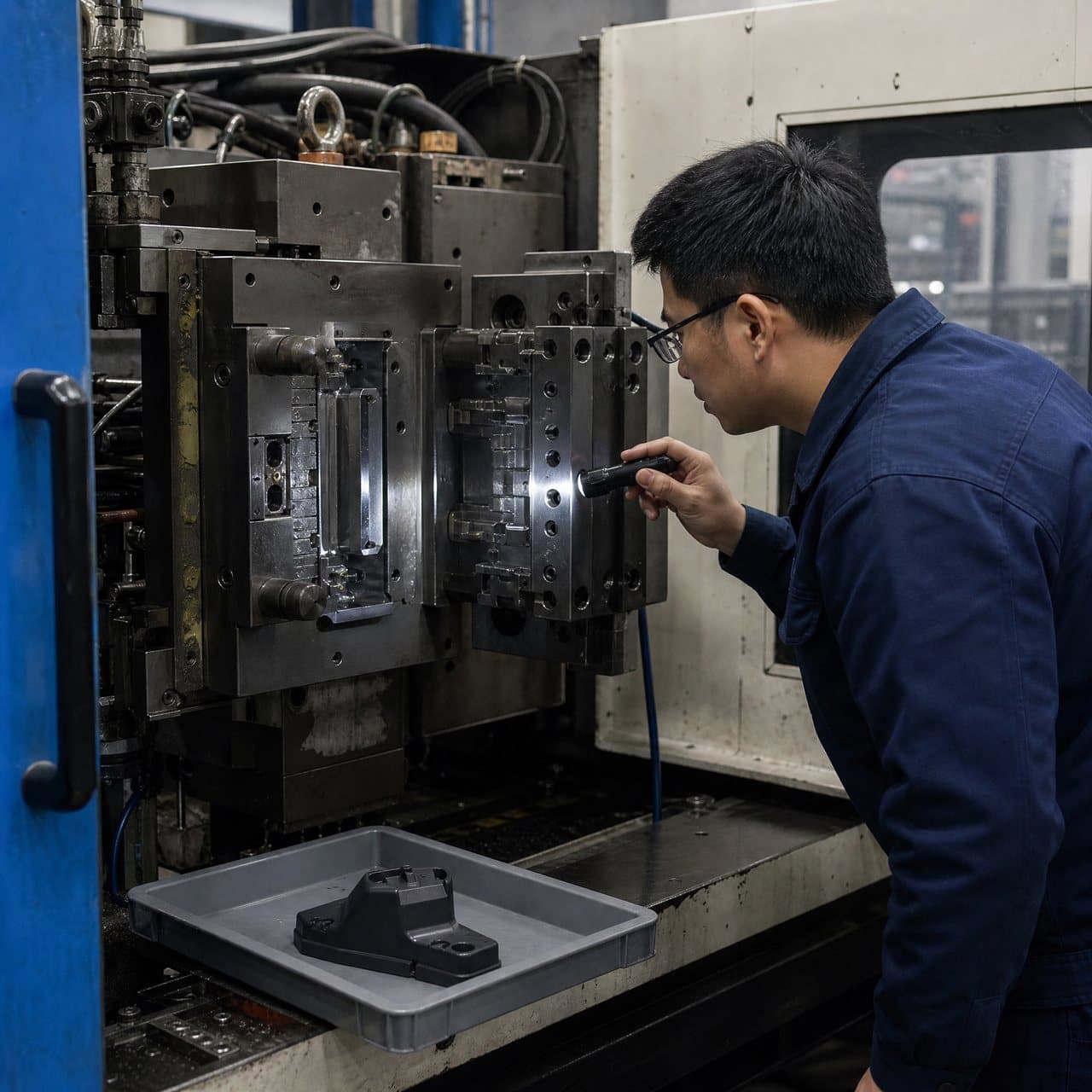
Embed Sampling in Injection Molding Quality Control
Connect release sampling to incoming material checks, start-up approval, in-process inspection, final inspection, packaging verification, and shipment release. At start-up, define the agreed checks for CTQs, cosmetic zones, resin details, color references, cavities, and functional features. At final inspection, take a representative sample from the defined lot, not only accessible cartons or visually favorable parts.
Treat a tool modification, repair, resin or color change, additional cavity, material-source change, machine move, recurring defect, or change outside an agreed process window as a plan-review event. The project may then require refreshed first-off data, focused CTQ measurement, new visual limits, or revalidation before routine release sampling resumes.
05
Require an Auditable Injection Molding Quality Report
Require a controlled injection molding quality report for each agreed inspection event. It should show buyer and supplier part numbers, revisions, purchase order or lot, quantity presented, selected sample, inspection date, tool and cavity traceability where applicable, resin and color traceability where applicable, equipment, CTQ results, visual findings, defect class, acceptance decision, and approver.
For measured CTQs, record actual values and units, not only pass/fail. For attribute inspection, record the sample quantity, count by defect class, acceptance/rejection rule, and final disposition. When a sample fails, identify and segregate the lot, prevent mixing or shipment, record the original result, investigate the cause, and use the agreed corrective-action, re-inspection, rework, or concession route. Do not resample informally merely to obtain a pass.
06
Use the Plan to Manage an Injection Molded Parts Supplier
Before nomination, ask the injection molded plastic parts supplier to review the plan against the drawing and manufacturing route. Confirm capability to identify cavities, preserve visual masters, segregate nonconforming material, and provide the agreed evidence. Specify capability studies and functional validation separately when they are needed; AQL does not replace them.
At trial approval, lock the drawing revision, resin grade, color reference, finish, CTQ method, defect catalog, packing requirement, lot definition, and report template. Then review trends: repeated minor findings, near-limit measurements, or rising rework can justify tighter controls even if individual lots pass. For a project-specific proposal, provide the drawing, model, intended use, demand range, CTQs, cosmetic-zone definition, destination needs, and requested quality evidence.

Practical takeaway
Before you move
to the next review.
- Define the lot boundary, lot identifier, and traceability links before choosing sample sizes or AQL values.
- Mark each injection molding CTQ with drawing reference, method, gauge, units, frequency, and decision owner.
- Agree critical, major, and minor definitions with annotated photos, visual limits, or unambiguous callouts.
- Name the sampling method, inspection level, project-confirmed AQL values, and acceptance/rejection rules for each class.
- State random-selection, failed-lot segregation, containment, investigation, re-inspection, and concession rules.
- Require a quality report with revision, traceability, sample basis, CTQ results, findings, disposition, and approver.
FAQ
Common questions
Is AQL the percentage of defects allowed in every injection molded shipment?
No. AQL is an index within a defined acceptance-sampling plan for a continuing series of lots. It works with the lot, sample size, and acceptance/rejection threshold. An accepted lot can still contain defects, so critical requirements need separate controls [1] [3].
Should every injection molding CTQ be checked by AQL sampling?
No. A safety-, regulatory-, sealing-, traceability-, or essential-function CTQ may need targeted measurement, process validation, or full verification. Document the method and release rule for each CTQ.
What should buyers do when an AQL sample fails?
Hold and identify the lot, prevent mixing or shipment, preserve the original result, and follow the agreed containment, corrective-action, re-inspection, rework, or concession process. Do not permit informal resampling only to obtain a pass.
References
Source material
- [1] ISO 2859-1:2026 — Sampling procedures for inspection by attributes — Part 1: Sampling schemes indexed by acceptance quality limit (AQL) for lot-by-lot inspection
- [2] National Institute of Standards and Technology — What is Acceptance Sampling?
- [3] U.S. Food and Drug Administration — Statistical Techniques, FDA Industry Conference
This guide is general information for early procurement and engineering discussion. It does not replace product-specific DFM, qualification, validation, regulatory assessment or legal advice.